Most people first encounter the Fibonacci sequence in a math class they half-remember. A teacher writes a string of numbers on a board: 1, 1, 2, 3, 5, 8, 13, 21. Each one is the sum of the two before it. The pattern keeps going indefinitely. And then the bell rings and everyone moves on.
What most people carry away is a single application (a sunflower, a sprint ceremony, a photography grid). The sequence is much wider than that. It shows up in the seed arrangement of a sunflower. In how photographers frame a shot that feels instinctively right. In the resonance physics of a tuning fork. And at the start of every sprint, in how agile teams estimate the complexity of their work.
That’s not a coincidence. It’s a signal. A pattern this consistent across biology, design, physics, and methodology is worth understanding.
what it is.
The rule is simple: each number is the sum of the two before it. That’s it.
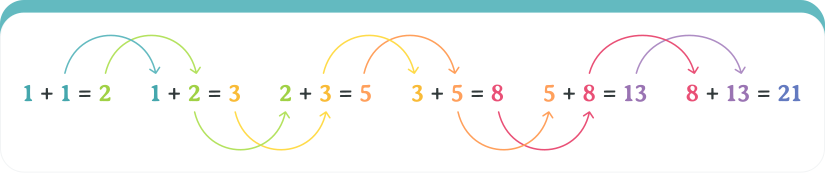
As the numbers grow, something interesting happens. The ratio between any two consecutive numbers gets closer and closer to approximately 1.618. Mathematicians call this the golden ratio, represented by the Greek letter phi. It’s not just a curiosity. It describes how natural systems grow efficiently, how visual compositions feel balanced, and as we’ll see, how complexity scales in ways that match how humans actually think.
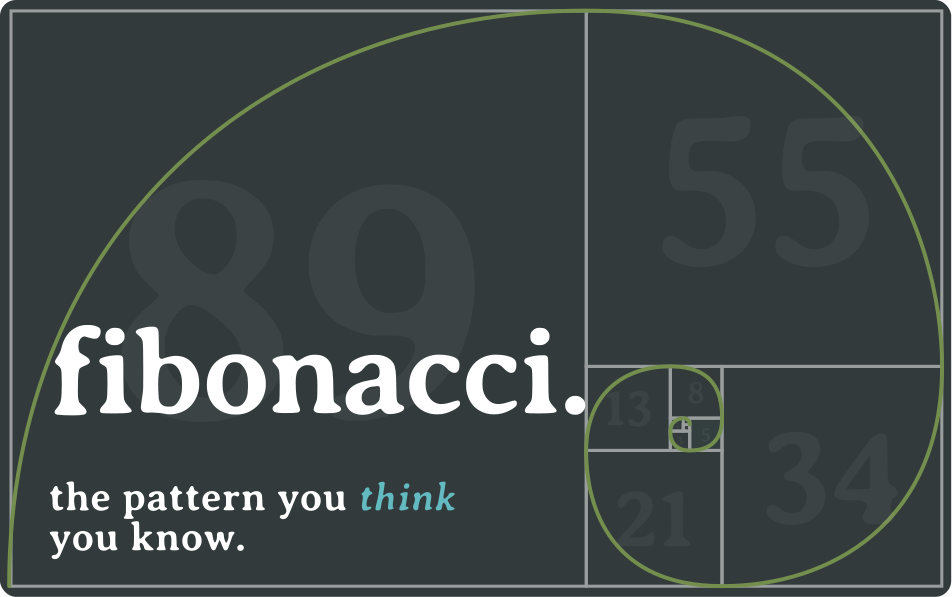
One more thing worth knowing before we go further. The golden spiral you see in design and photography (the one that guides the eye through a well-composed frame) is drawn from those same proportions. Each step in the Fibonacci sequence produces a rectangle whose sides are closer to the golden ratio than the step before it. The spiral connects the corners of those rectangles. So the Fibonacci sequence and the golden spiral aren’t the same thing. They’re related: the sequence is the path, the spiral is what you draw when you follow it. Nature, it turns out, has been following that path for a very long time.
nature figured this out first.
A sunflower doesn’t pack its seeds randomly. It arranges them in two sets of spirals, one curving clockwise and one counterclockwise, and the counts of those spirals are almost always consecutive Fibonacci numbers. 34 and 55. 55 and 89. This arrangement allows the sunflower to fit the maximum number of seeds into a circular space with no gaps and no overlaps. It’s the most efficient solution to a geometry problem, and no mathematician designed it.
The nautilus shell is probably the most famous example people reach for here, and it’s worth being precise: the shell is a logarithmic spiral, meaning it grows at a consistent rate as it expands outward, which is why it maintains the same shape throughout the animal’s life. That consistency is genuinely beautiful, and it shares the same mathematical family as the Fibonacci spiral. The specific claim that it expands at exactly the golden ratio has been measured and doesn’t hold up, but the underlying principle (that nature favors consistent, proportional growth) absolutely does.

Romanesco broccoli: each floret is a smaller version of the whole, arranged in Fibonacci spirals.
Pinecones, romanesco broccoli, the arrangement of leaves on a stem to maximize sunlight exposure. The same principle keeps appearing because it solves the same underlying problem: how to grow, pack, or distribute efficiently in space. The sequence isn’t imposed on nature. Nature arrived at it independently, over and over, because it works.
why photographers and designers use it.
You’ve probably heard of the rule of thirds, the idea that placing your subject off-center, at the intersection of an imaginary grid, makes a photograph feel more dynamic. The rule of thirds is a simplified approximation of something more precise: the golden spiral.
When you overlay a Fibonacci spiral on a well-composed photograph, the subject often sits near the center of the spiral. The horizon line follows one of its curves. The eye moves through the frame along the path the spiral traces. The composition feels right not because of convention but because the pattern matches how the eye naturally wants to move.
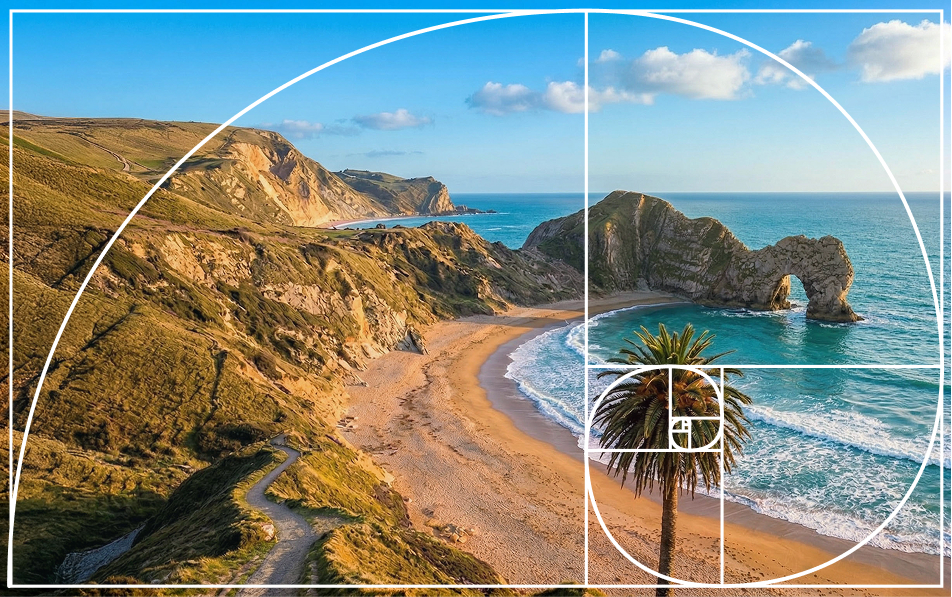
The golden spiral moves the eyes through the composition: the path, the ridge, the arch, the horizon.
Master painters worked this way centuries before cameras existed. Da Vinci structured The Last Supper around it (the room dimensions, the table, the placement of figures). Hokusai’s wave. Trained eyes and mathematical curves tend to arrive at the same place. The golden ratio creates visual harmony because it mirrors the proportions found in the natural world, and our eyes recognize it even when we can’t name what we’re seeing.
sound has a sequence too.
This one requires a little more explanation, but it’s worth it, especially if sound therapy or acoustics is part of how you think about wellness.
When a string or a column of air vibrates, it doesn’t produce just one frequency. It produces a fundamental tone and a series of overtones above it: the second harmonic at twice the frequency, the third at three times, the fourth at four times, and so on. This is called the harmonic series, and it’s the acoustic foundation of all music.
The ratios between harmonics that the human ear perceives as consonant, as resolved and pleasing, are simple whole-number ratios: 2:1 (an octave), 3:2 (a perfect fifth), 4:3 (a perfect fourth). These aren’t arbitrary. They’re the lowest, simplest ratios in the harmonic series, and the simplicity is what makes them feel stable.
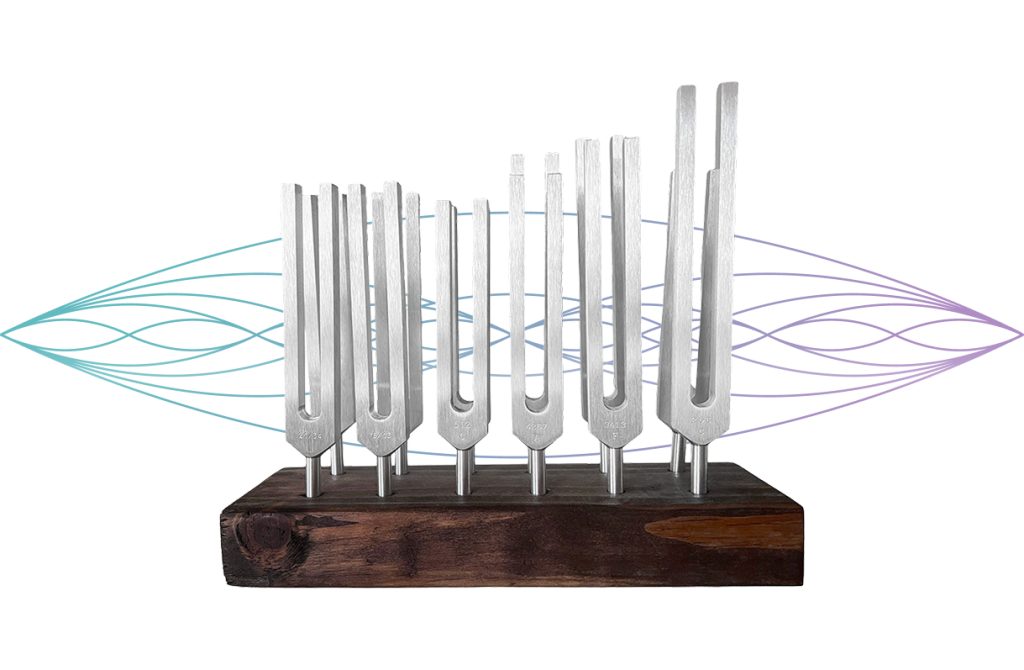
Tuning forks produce pure tones whose harmonics follow the same proportional relationships as Fibonacci ratios.
Where Fibonacci enters: as the sequence progresses, the ratios between consecutive numbers converge on the golden ratio. And the golden ratio appears in the spacing of harmonics that feel most natural to the ear. The connection is proportional, not a direct one-to-one mapping, but it points to the same underlying truth. The most resonant, stable relationships in sound follow the same mathematical proportions found in shells, seeds, and spirals. This is part of why certain frequencies feel grounding. The physics of resonance and the geometry of nature are describing the same pattern from different angles.
The most resonant relationships in sound follow the same proportions found in sunflower seeds and pinecones.
The physics and the geometry are describing the same thing.
and then there’s sprint planning.
At the start of each sprint, agile teams sit down to estimate the work ahead. Someone describes a task. The team votes on how complex it is. And the values on the cards they use aren’t 1 through 10. They’re Fibonacci numbers: 1, 2, 3, 5, 8, 13, 21.
A lot of teams use t-shirt sizes instead. Small, medium, large, extra-large. It’s intuitive and fast. We prefer Fibonacci, and we use it in our own sprint ceremonies with clients, because the sequence does something t-shirt sizes can’t: it accurately represents how complexity, uncertainty, and effort actually scale together.
A 1 is clear. You know exactly what it is, what it requires, and how long it will take. A 2 is mostly clear with a small amount of uncertainty. A 3 introduces more. But notice what happens at 5. The gap between 3 and 5 is larger than the gap between 2 and 3. And the gap between 8 and 13 is larger still.
That’s not arbitrary. It mirrors something real: the difference between “mostly understood” and “pretty complex” is not the same size as the difference between “pretty complex” and “genuinely uncertain.” Complexity, uncertainty, and effort don’t scale linearly. The Fibonacci sequence captures that. It gives teams precise language for small, well-understood work while building in room for ambiguity as the numbers grow. A 13 doesn’t mean “13 times harder than a 1.” It means “we’re not sure, and the gap between what we know and what we don’t is significant.”

The AROO planning poker tool. Fibonacci values, used in sprint planning and backlog refinement exercises.
This is what precision of understanding looks like in practice. Not a false exactness that pretends all estimates are equally certain, but a scale that honestly represents where the gaps are.
why the same pattern keeps showing up.
The Fibonacci sequence appears in nature because it describes efficient growth. It appears in visual composition because the eye is drawn to proportions it recognizes from the natural world. It appears in acoustics because the simplest harmonic ratios converge on the same proportions. And it appears in agile estimation because it accurately represents how complexity, uncertainty, and effort scale together.
These are not four separate discoveries of the same mathematical curiosity. They’re four different disciplines pointing at the same underlying truth: some patterns are just true. Not because we decided they were, but because they describe how things actually work at a structural level.
At AROO, we’re drawn to those kinds of truths. The ones that hold up across domains. The ones that show up in biology and boardrooms, in acoustics and sprint reviews. The ones that were true before anyone named them.
That’s the “from woo woo to woo hoo” principle in action. The ancient patterns were never mystical. They were just waiting for enough context to be understood.